Did you know you can live life with your credit card actually paying you money on an annual basis?
I spent over twenty years completely oblivious to this, thinking that my credit cards were just another expense I had to live with. But now I know better, and my credit card pays me money every month. Here’s something the banks definitely don’t want you to know about. It will take some effort, some frugality, and some disciplined finances, but you can get to the point where your credit card is paying you $500, $1,000, or more a year.
I know, because I did it. Eventually. After doing the opposite for two decades.
Over that time, carrying a Vancity Visa with an 11.9% interest rate and a balance that peaked at $15,000, I paid out roughly $18,500 in interest and fees. (I know that number because, as a self employed person, I can “write off” my credit card interest and fees, and did so every tax year).
Eighteen thousand, five hundred dollars. For the privilege of borrowing my own future money back to myself at a double-digit interest rate.
Smart. 🙄
The Debt Hole
The debt had a slow, creeping arc. I got a Vancity Visa Classic Gold card in 1999. By 2006 I was carrying over $5,000 in debt most months. By 2015, I’d somehow managed to drag it up to $15,000. During COVID in 2020, when you’d think enforced lockdowns might have helped, it was still sitting around $12,000 monthly debt. Years of telling myself I’d get serious about it, followed by years of not getting serious about it.
In 2021, something finally broke in me regarding this debt. I decided, with the kind of clarity that only comes from staring at a number that has embarrassed you for fifteen years, that eliminating my credit card debt was my single, non-negotiable priority. Not “one of my priorities.” The priority. Everything else was secondary.
What followed was four years of fairly aggressive frugality. I stopped taking vacations. I budget-shopped groceries, which, if you haven’t done it seriously, is a considerably different and more time-consuming activity than just buying groceries. I kept my phone well past the point where my carrier contract expired, which in Canada is its own special kind of stubbornness. I dwindled down our dining out by over 50%. Every decision ran through the same filter: does this help pay down the card, or does it not?
If not, it waited.
In late 2024, I got my credit card debt to zero. It was such an exciting day that I celebrated by buying a $25 bottle of Late Vintage Port and drank it with my wife on the back deck. It’s all I could bring myself to pay for.
Maintained that zero debt level for six months to make sure it wasn’t a fluke. Then I started thinking about what came next. What came next was switching cards.
Disciplined Financial Choices
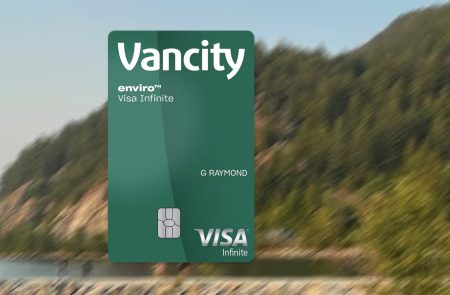
Vancity offers their enviro Visa Infinite at $120 a year. The interest rate is the usual obscene 19.9%, which would have horrified 2015-me, but zero-balance-me doesn’t lose a moment’s sleep over it. What I cared about was the points structure, which is dramatically better than my old card. Ten points per dollar at local businesses. Five points per dollar on transit. Two and a half points per dollar on groceries. One and a quarter points on everything else.
I have two credit cards now: a low interest personal use card through my other credit union, and this Visa Infinite card. All my business spending goes through the Infinite card, which can amount to $10,000 to $15,000 a year. I also put all my groceries on this card, but clearly track the expense so it remains separate from my business expenses. All told, I’m moving around $2,500 to $3,000 a month through the card. The points accumulate a lot faster at those multiplier rates.
There’s also some small things worth doing to accumulate more points. I used to pay business expenses like my monthly smartphone bill, annual car insurance, or internet bill through my bank via direct billing, but no longer. I now pay them through the card, collect the extra points, and just pay down the card to zero each month.
In my first full year with the card, I earned enough points to apply $725 toward my Visa bill. My total interest charges for the year were $12, from one month where I missed the 20-day grace period by three days. Net result: the card paid me $713, less the $120 annual fee.
Speaking of that fee, there’s another layer to this, which depends on whether you can keep a meaningful amount sitting in your chequing account. Vancity’s Total Chequing Account – their top of the line, top perks account – costs $26 a month fee, unless you maintain a minimum $6,000 balance, at which point the monthly fee drops to $zero. The account includes free bank drafts, free cheques, lots of travel perks, reduced or eliminated fees on international ATM withdrawals, and, critically, it will cover up to $150 of your annual Visa card fee. My card is $120, so it covers the whole thing.
I did the maths on keeping $6,000 parked in that account. The combined savings, zero monthly banking fees, no international withdrawal charges, free drafts and cheques, plus the card fee covered, adds up to around $550 a year. On a $6,000 deposit, that’s roughly a 9% effective annual return. My bank is “paying me” (technically, it’s saving me from paying) nine percent to keep money in a chequing account. Not complaining.
So the full picture: $715 back from the card, plus $550 in banking savings. Together, they’re paying me and saving me over $1,200 a year. All the for the cost of maintaining $6,000 in that business account and paying off my credit card debt each month. Compare that to the $1,100 annual net loss I was running before just on the credit card interest and fees, and the $300 I was paying over each year in bank fees. That’s a swing of well over $2,600 a year, in my favour. That is real money.
Can You Do This Too?
I’m aware this is a Vancity-specific setup, and Vancity operates in British Columbia. If you’re elsewhere in Canada, your bank almost certainly has equivalent structures, particularly the credit unions, which tend to be more straightforward about this kind of thing than the big five. Do the maths on your own bank’s premium chequing account. The minimum balance threshold model is common, and the savings frequently justify maintaining it, especially if you are self employed, need physical cheques, or travel for business. In my case, three writers for my website prefer getting paid by cheque, so I just draw US-fund bank drafts for them, saving $10 in fees for each one.
For American readers, the landscape is actually more favourable, which is mildly irritating to admit as a Canadian. The US credit card market is considerably more competitive, and premium cards from issuers like Chase, American Express, and Capital One routinely offer higher sign-up bonuses, better multiplier categories, and more aggressive travel benefits than their Canadian equivalents. Americans have more options, and frankly, better ones.
The fundamental principle here, eliminate the debt completely before you think about rewards, applies equally on both sides of the border. But once you get there, the ceiling for what an American card can pay you is noticeably higher.
The hard part, for Canadians and Americans alike, is getting there. Four years of frugality is not an abstraction. It is specific, repeated, sometimes tedious decisions, made over and over again, that collectively add up to a number going down instead of up. It is not exciting. There is no shortcut that works. But the destination is a version of your financial life where the bank is working for you, not the other way around.
Eighteen thousand, five hundred dollars is what the previous arrangement cost me. I find that number clarifying. Now it’s one thousand, five hundred dollars in my pocket, every year. That is liberating.
Stop paying them. Make them pay you.