Can a $9 croissant keep you poor? I think it can. I’ll show you how, and how to break out of it and get one of the best “non-social-influnced” feelings in the world: watching your money earn an income on its own.
What follows could be my own story, or it could be a hypothetical. I’ll leave that up to you to decide.
Functionally Poor
In 2010, 45% of my income went to rent. Forty-five percent. Before groceries, before the phone bill, the internet bill, before a single thing that might be called fun.
I felt poor. Functionally poor. And when your biggest bill isn’t negotiable, it’s hard to imagine a way out.
By 2013 I was $35,000 in debt, spread across a Visa, a Mastercard, and a bank line of credit that I lived in at around 8% interest. The cards were charging me 11% to 20%. Being self-employed, I didn’t even have the luxury of a regular paycheque to chip away at the debt. Sometimes I’d wait two or three months for the next cheque to arrive, and I’d use credit to bridge the gap, which only made the hole deeper.
I didn’t climb out of that crushing debt with a magical job paying 300% more. I did it with three boring things: frugality, no vacations or luxuries, and investing through a TFSA.
I’ll get to the TFSA. First, the part I really want you to hear.
The Little Treat Economy
Look, I get it. When you feel there’s no financial future for you, no home ownership, maybe not even a car, dropping $6 on a freshly made matcha feels like a tiny win. Spending $7 on an “artisan crafted” croissant feels like a small slice of victory. It doesn’t even feel like spending. It feels like a reward. You can’t get the big things, so you take the small wins wherever you can.
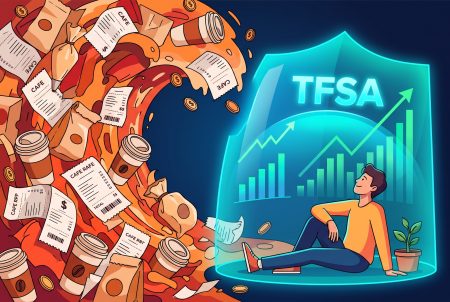
That’s the “little treat economy.” A $6 latte on the way to work. A $7 pastry because it’s been a day. A $15 cocktail on a Thursday, a $75 pub night on a Friday, because damnit, you deserve it after the week you had.
None of it seems like a bad decision. You don’t agonize over a matcha or a soy latte. It’s one of the tiny luxuries you allow yourself. And that right there is the trap.
In 2012, I added up all my “little treat” spending, every completely discretionary, “makes me feel good for five minutes” purchase. Lattes, pastries, cocktails, pub nights. About $6,500 a year.
I stared at that number for a long time. It was money I never noticed leaving, buying feelings that were gone by dinner.
Prices have only gotten worse. Today a $9 croissant and an $8 matcha is $17 before tip and taxes. That’s $17 you no longer have to put toward one share of a tech giant ETF, a share that might be worth $21 by the end of the year. The croissant is gone by ten in the morning. The share is still there, working for you.
Now let’s zoom out. Say you spend an average of $10 a day on pure little-treat stuff (and I’m being conservative). Some days it’s $30, some days zero. You might go a week without spending a dime, then blow it all on a Friday Skip the Dishes order that runs $75 with fees, tips and markups, for something you could have made at home with $12 of ingredients.
That’s $70 a week. Roughly $300 a month. Over $3,600 a year.
Historically, a diversified portfolio of stocks and ETFs has averaged somewhere around 7% a year over the long haul. Not every year, and never guaranteed, but it’s a reasonable planning number. Here’s what $70 a week looks like at 7%: about $1,860 in six months. $3,800 after one year. $21,750 after five years. And a staggering $53,000 after ten.
I did the maths twice, because I didn’t believe it. All from $10 a day. Those croissants, that matcha, that $15 pint of artisan ice cream, turned into $53,000. You only contributed $36,400 of it. Your money made the other $16,600 on its own.
Just for shits and giggles, run it again at 10% a year in gains and dividends, which has been very achievable since 2012. You’d have about $1,850 in six months, $3,850 after a year, $23,500 after five, and $62,500 after ten. Same $36,400 put in. Your money earned $26,100 without lifting a finger.
I’m not saying never eat a croissant. I’m saying know what it costs, and don’t be fooled by tap-to-pay, where you never see the cash leave your pocket. In 2012 I cut about 80% of my treats for a year and banked the difference. I kept roughly $1,300 worth of treats, because a person has to live. I also quit upgrading my phone every eighteen months, and banked that money too.
The First Five Hundred Bucks My Money Made
All that banked money went into my TFSA. A quick aside for my American readers: the Tax-Free Savings Account is a Canadian thing, and your closest cousin is probably a Roth IRA. Money goes in, it grows, and when you take it out, you pay no tax. Tax free, forever. It’s one of the best tools Canadians have, and a lot of us ignore it.
I started with $250 a month. Then $300. Then $400. My credit union managed it in mutual funds returning about 6% to 8.5% a year. After twelve months I had roughly $6,000 invested, and it had earned about $500 in gains and income.
Five hundred dollars won’t change your life. But for the first time in my life, I used money to make money.
It was a WOW moment.
The Investor Class
Let me tell you what I mean by this, because it’s the whole point.
You may have heard the term “Investor Class.” I have my own definition. Anyone who uses their money to make more money through investments is in the Investor Class. That’s it. Not $10,000 a year. Not $50,000. Not a million. It can be $500 or $500,000.
The day your money starts earning its own money, you’re in. You’ve stopped being someone who only trades hours for dollars. You don’t need a fortune to join. But you do need to start.
Luck, and a Line I Won’t Cross
I let my credit union manage my TFSA for the first year or so, then I learned you can self-manage it. Bank and credit union managers play it super safe. They don’t want you to lose money, but they’re not exactly hunting to make you a ton of it either. So I did my research, took over, and started building a stock and ETF portfolio inside the TFSA.
Two purchases were amazing: Tesla and Meta, both bought in their early years. When I cashed out, Tesla was up about 3,500% and Meta close to 3,000%. Those two alone erased about three-quarters of my credit debt.
That was luck and timing. Don’t count on returns like that. But always do your research, like I did, and know that self-investing isn’t for everyone.
Speaking of Tesla, I would never buy it, or any Elon Musk company, ever again, even if it returned another 3,500%. I have morals. I lost all respect for Elon soon after he bought Twitter. Then he basically bought the 2024 election for Trump. Then he did his DOGE stuff, where I believe he harvested every byte of data he could get his hands on for his own gain. Then the Nazi salute. I believe Elon is evil. I believe he’s a fascist. I bring ethics and morals to my investment strategy, and I think you should too.
Moving on.
Round Two
By 2020, I’d gone from $35,000 in debt in 2013 to zero, with a $120,000 portfolio. I had “done it.”
Then business decisions, setbacks and COVID hit. My income dropped 70% over 2020 and 2021. I withdrew from the portfolio to stay afloat, and it fell to around $60,000. A few months into COVID, my credit debt was back up to $12,000.
I almost had to start over. So I did.
I paid off the cards first (I’ve detailed this another post about credit card debt), and I sold investments to do it. At 11% to 20% interest, debt crushes you. Then I went 100% frugal again. No treats. No vacations. The same phone for three to four years. No new laptop or camera gear, which is how I make money, so that one stung.
By the end of 2024: zero credit card debt once again, and money flowing back into my TFSA.
What I’d Do Differently
Here’s the part that still makes me wince.
Back in 2012 to 2015, I split my money. Some went into investments, and some went into partial payments on the cards and the line of credit. It felt balanced. It felt smart.
It wasn’t. My cards were charging 11% to 20%. My mutual funds were returning 6% to 8.5%. The math isn’t close.
If I had it to do over, I’d make paying off the high-interest debt priority number one before I invested a single dollar. Every dollar you send to a card at 20% interest is a guaranteed 20% return. Nothing in the stock market will promise you that.
Learn from my mistake. Pay off your high-interest debts first. (A mortgage isn’t high-interest debt. A credit card or line of credit is.)
Where It Landed
Today I put about $500 a month into my TFSA, and I never miss a month. That’s one of the real secrets of financial independence. It doesn’t matter how much or how little you invest, only that you invest something every single month. Treat it like a debt payment, except it’s owed to your future self.
I’ve had an excellent run between 2022 and 2026. Some of the ETFs and stocks I picked ran hard, with 90%+ capital appreciation over three years. I want to be clear: that is not normal, so don’t bank on it. In bear markets your investments will lose value. Don’t panic, and don’t sell in a frenzy. Keep buying, especially on the dips.
This past year my TFSA produced roughly $23,000 in new money. That’s dividend income, realised gains from sold stocks, and unrealised growth, all tax free. The dividends get used to buy more ETFs and stocks, so the pile keeps feeding itself. Next year I’ll pass $30,000 in annual capital growth.
Money working for me, not just me working for money.
The three biggest joys of my life that don’t involve family, friends, love or pets all came from financial things:
- Zeroing out my credit card debts (I did it twice! Best feeling ever!)
- Buying my first home (a condo in Vancouver)
- Watching my money earn money on its own, without any work on my part
Your Turn
Here’s the whole plan, no magic in it:
- Kill the high-interest debt first. Constant payments, and no new debt. This is crucial and core.
- Once the cards are clear, automate a monthly investment, even if it’s just $100 to start. Then put every spare dime you can into it.
- Start boring. Low-fee global index ETFs like ZEQT, XEQT, VEQT.
You’d be surprised how much debt disappears when you cut 75% of the little treats. And when the debt is gone, the money you used to send to the banks goes to your future self instead. That’s the double win.
Now let me be straight with you. Rent, groceries and everything else won’t shrink because you skipped a matcha. I know. I was giving up 45% of my income to a landlord. But the little treat economy is the one leak in your budget that’s entirely yours to plug, and plugging it is how I went from functionally poor to someone whose money earns a salary of its own.
So, back to where we started. Can a $9 croissant keep you poor?
Not by itself. But nine bucks here, eight bucks there, tap, beep, tap, beep, for ten years? That’s $53,000 you never even met.
The croissant is gone by ten in the morning. The share is still there, working for you.
Stop paying for five-minute feelings. Start paying your future self. Welcome to the Investor Class.
This is not financial advice. I’m not a financial advisor. Do your own research, and talk to a professional before you invest.