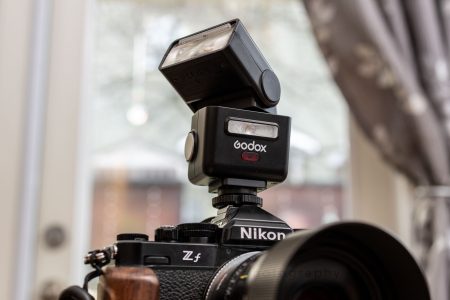
For years, as a professional photographer, I’ve written off the Godox brand when it comes to flashes. Rather ignorantly, it seems, because their AD200 big flash system was ground breaking for studio work.
No, during my career, I’ve focused on having Canon flashes for my Canon camera systems. My workhorses are the 600EX-RTs, which I thought were kinda photo-magical for the time because they operated on their own wireless network (little did I know that Canon was not the real innovator in this arena). I ended up buying 3 of them at well over $600 each. And then a 430EX-RT III to have a fourth flash (at $400). Then I spent another $400 on a Canon ST-E3-RT, to control the flashes.
That’s painful $2800 in lighting gear. And they only work with one system, the Canon cameras.
Meanwhile, Godox has had their X System running on 2.4GHz wireless since 2015. The real genius here is how it breaks the “system dependence” lock. If you want a multi-flash setup for weddings or product shots, you aren’t stuck: you’ve got options I never had.
Here is how it works. You still have to buy the flash that fits your camera’s hotshoe. Godox makes a V1 or a V860 (essentially a full blown clone of the Canon 600-EX-RT) for Canon, one for Nikon, one for Sony, and so on. If you are like me, you shoot pro on one system (Canon), but you have “fun” cameras too. Maybe a Nikon Df, a Fujifilm X100T, or an older Olympus.
If you bought official flashes from the big brands, you are marrying those lights to those specific cameras. If you wanted a three-light setup for your main Canon rig, you’d have to buy three specific Canon flashes. Now you are sitting on an inventory of seven or eight different lights just to cover your bases. It’s a mess, and a heavy hit to the wallet, especially if you’re paying Nikon or Canon Speedlight prices.
Godox changed the maths. In 2017, you could buy an X1T transmitter for your pro setup Canon, and, quelle surprise, that transmitter can take control of the Godox flash you bought for your Nikon, and the one you bought for your Fuji. That transmitter makes all those flashes work flawlessly with your Canon system, giving you full TTL, metering, and even High Speed Sync. You just saved yourself from buying three extra Canon speedlights. Or the expensive Nikon and Fujifilm flashes.
That really hit home when I saw a pro shooting product shots for a coffee vendor just before COVID. He had three Godox V860s running. One on his camera acting as the master, and two off to the sides. He told me one remote flash was a Nikon mount and the other was for Fujifilm.
For a setup that cost him maybe $900, he had the same capability as my $2800 Canon kit. And unlike my gear, he could grab those off-camera flashes and use them on his other bodies anytime he wanted. Must have been nice.
Godox wasn’t done yet.
The Real Game Changer
I hate using the term “game changer”, unless it’s actually worthy. Over on the coffee site, you’ll note I rarely use it. But I am convinced Godox is a master game changer right now. It has to do with a little $100 flash called the IT32.
But I’m getting ahead of myself because there’s the X3 Nano and IT30 Pro that came just before the IT32, and they helped change the game too.
The X3 Nano
My Canon ST-E3-RT wireless transmitter and flash control is janky – a big hockey puck on top of the camera with a sometimes hard-to-read screen, too many physical buttons and the batteries die quickly in it. But it gets the job done.
Godox’s original transmitters for their X System 2.4ghz wireless controls were even more janky and fiddly. So in 2024, they fixed that. They rolled out their X3 Nano controller. Touch screen controls. Tiny. Battery lasted all day. And an interface that just made sense. Not only worked with all legacy and current Godox flashes (and big flash heads like the venerable AD200 Pro), but brought new features to the flash control system. I tested one with my Canon R6 Mk II briefly – it even worked within the Canon flash control system in-camera. Impressive.
The X3 also made pairing and controlling all newer Godox Flashes (any that had firmware updates) easier via a simple one touch sync mode. No more fiddling with channels and IDs; set your channel and ID on the X3, then sync all the other flashes via the touch interface and Bob’s your uncle.
Best part? $90USD!!!! The Canon radio controller / transmitter is like $350!
The IT30Pro
This little flash was Godox’s answer to a well loved and short lived flash, the Fujifilm EF-X20 (which sells used on eBay for like 3x it’s original MSRP). Godox saw the market, and decided, yeah, we can do that flash again.
But they did it way, way better. They basically did the EF-X20 flash, but jammed and ever slightly dumbed down X3 Nano into it, touchscreen included (it doesn’t show as many flash groups as the X3 does). They even included a rotary dial (the EF-X20 had one) to give you that tactile feel. And for shits and giggles, they did the flash in Fujifilm Silver as well as black.
That new flash is the IT30 Pro, and up until just a few months ago, it was the absolute darling of the influencer crowds on Youtube and Instagram (ok, it still is, but something else just recently took over the “darling” mantel).
Also, this amazing flash is often cheaper than the X3 Nano! It was introduced at $85, but is now around $75 in the US (and around $105 in Canada). A full blown, wireless transmitter and receiver, high speed sync, multi strobe, TTL and full M flash, for $75.
The IT32

If the X3 and iT30 Pro were kinda game changers, the Godox iT32 is a legit, ceiling-shattering, run-the-score-up-to-a-gazillion game changer.
Here is why I’m using all the superlatives. The iT32 solves the two biggest headaches I’ve had with lighting for the last fifteen years. And it does it with magnets.
The first headache is the “system lock” I complained about earlier. Godox realized the flash tube and battery don’t need to know if you are shooting Canon or Nikon or Leica. Only the hot shoe pins care about that. So they separated them. The iT32 isn’t a flash with a foot; it’s a modular head that snaps onto a tiny $20 transmitter called the X5. The X5 handles the camera-specific TTL talk, while the head handles the heavy lifting, effectively packing a full-blown X3 Nano interface inside.
This is brilliant. The flash has no allegiance. I bought one iT32 flash and three X5 modules: one for Canon, one for Nikon, and one for Fujifilm. It just magnetically snaps onto whichever camera I pick up that morning. No more duplicate gear for my “fun” cameras. You can even get a Leica X5 module (which costs $34, because, you know, Leica).

The second headache is the clumsy dance of switching from on-camera bounce to off-camera lighting. Usually, that involves stopping the shoot, digging in your bag, swapping the flash for a trigger, and hoping everything syncs.
With the iT32, you just yank the flash off the camera. That’s it.
Because the connection is magnetic, the head pops off, but the X5 trigger stays locked in your hot shoe. The system instantly detects the separation. The thing in your hand becomes a wireless radio slave, the thing on your camera becomes a master. No buttons, no sub menus to dial through. No “wait for the flash…”. Just grab the light and move it. It is the most fluid way to shoot with artificial light I have ever experienced.

For street photography, this is beyond brilliant. Want that (stupid) trendy direct flash look? Shoot with the iT32 on-camera pointing straight ahead. Want side fill? Yank it off and hold it at arm’s length. Want a halo light? Place the iT32 behind the subject and fire away.
And it doesn’t stop there. If you’re using the iT32 to both fire and control other wireless Godox flashes, yanking the head off doesn’t break the chain. The X5 keeps transmitting, so your other lights still fire with full TTL and FEL prefires. I only own two Godox Flashes – the iT32 and the iT30 Pro (Fujifilm shoe) – and they control each other seamlessly.

And again, the price makes me want to cry about my old Canon receipts. The whole setup of the iT32 and one X5 module costs about $100USD (and around $138 in Canada). That is less than the sales tax I paid on my old speedlight setup.
Reality check: this isn’t a powerful flash. At GN 18 with no zoom, it has less than half the muscle of my Canon 430EX III-RT. Still, the Li-ion battery recycles faster than the Canon, and three of them could handle most studio tasks with a couple living inside some bowens-mount softboxes and octagonal umbrellas. It also has a decently bright LED modeling light, though it feels like a bit of a gimmick.
But that doesn’t matter. I am sure this is just the first version. I have no doubt Godox is planning bigger variants using the same X5 bases, including a likely a competitor to the Canon EL-5 ($550 CAD). And where the Canon EL-5 won’t even work on older DSLRs like the 6D Mk II, Godox’s flashes will work on everything thanks to a $20 magnetized adapter.
Ten years ago, I spent $2,800 on a flash system so I could have wireless control, group TTL, and decent recycle times. Today, I could spend $440 and get the same control, but with four flashes I could easily interchange between Canon, Nikon, Fujifilm, and Leica bodies. I am so impressed with this brand, I’m taking a second look at their AD series, the AD100, AD200 and AD400s, for possible use on the road and in my photoshoot kitchen and side room setups.
Technology is amazing. And I love that this third party flash maker is basically rewriting the book on what speedlights are capable of. They feel like they’re leaving Canon and Nikon in some deep 20th century dust.